
Heat Transfer
To build a clear scientific understanding of heat transfer, it is essential to recognize how thermal energy exchanges and why different mechanisms exist. Heat transfer occurs through three fundamental modes: conduction, convection, and radiation. These modes can be grouped by whether material presence is required for heat propagation. Regardless of the heat transfer mechanism, the existence of a temperature gradient is the fundamental cause of all modes of heat transfer.
1. Material-Dependent Heat Transfer
Conduction
Conduction is the transfer of heat through a solid, liquid, or gas without any bulk movement of the material. Thermal energy flows from more energetic particles to less energetic ones through direct molecular interactions. This mechanism dominates in solids but also occurs in stationary fluids.
Convection
Convection involves the transfer of heat by the motion of a fluid—either a liquid or a gas. Mobile fluid particles carry energy as they move from one region to another. Convection combines microscopic molecular transport with macroscopic flow, and it becomes significantly more effective when turbulence is present.
2. Material-Independent Heat Transfer
Thermal Radiation
Radiation is the emission of electromagnetic waves generated by the thermal motion of particles within matter. Any object above absolute zero emits thermal radiation. Unlike conduction and convection, radiation does not require a medium—meaning it can transfer heat through empty space as well as through gases, liquids, or solids.
3. Fourier’s Law of Heat Conduction
Fourier’s Law describes how heat is transferred through a solid material by conduction. It states that the heat transfer rate is proportional to the temperature gradient and the area through which heat flows:

or

Here,
- Q is the heat transfer rate (W),
 is the thermal conductivity of the material itself (W/m·K),
- A is the cross-sectional area (m²),
- dT/dx is the temperature gradient (K/m),
- The negative sign indicates heat flows from higher to lower temperature.
The thermal conductivity describes how effectively a material conducts heat. Materials with high (such as metals) transfer heat rapidly, while those with low (such as insulation materials) resist heat flow.
Another important property is the thermal diffusivity α, defined as:

here material properties are:
- α is thermal diffusivity,
- k is thermal conductivity,
 is density,
 is specific heat capacity,
which represents how quickly a material responds to changes in temperature.
A material with high thermal diffusivity conducts heat efficiently and has low thermal inertia, meaning temperature variations propagate through it rapidly.
Conversely, materials with low thermal diffusivity warm up or cool down slowly because they store heat more effectively.
Together, thermal conductivity k indicates how fast heat flows, while thermal diffusivity α indicates how fast temperature gradient spread within a material.
4. Convection Heat Transfer – Newton’s Law of Cooling
While Fourier’s law describes heat conduction within a solid, heat transfer between a solid surface and a moving fluid occurs via convection. This process is commonly described by Newton’s law of cooling, which states:

or

Where:
 is the convective heat transfer rate
 is the convective heat transfer coefficient [W/(m²·K)]
- A is the surface area
 is the solid surface temperature
 is the bulk fluid temperature far from the surface
5. Link to Fourier’s Law in the Fluid Film
Near the solid surface, the fluid forms a thin layer known as the thermal boundary layer or fluid film. Heat transfer within this layer can be modeled as conduction through the fluid, using Fourier’s law:

Where:
 is the thermal conductivity of the fluid
- dT/dy is the temperature gradient normal to the surface
Assuming the temperature drop occurs mainly across this thin layer of thickness δ, the convective heat transfer coefficient h can be defined by analogy with Fourier’s law:

This shows that h represents the effective ability of the fluid film near the surface to conduct heat. The thinner the boundary layer (small δ) or the higher the fluid thermal conductivity, the larger the convective heat transfer coefficient.
6. Energy Transport inside Fluid
The most general description of heat transfer in a fluid is given by the three-dimensional energy equation, which expresses the conservation of thermal energy within a moving fluid element. This equation includes the effects of fluid motion, thermal diffusion, and volumetric heat generation.
3-D energy equation is:
![\frac{\partial (\rho c_p T)}{\partial t} + \Bigg[ \frac{\partial (\rho c_p u T)}{\partial x} + \frac{\partial (\rho c_p v T)}{\partial y} + \frac{\partial (\rho c_p w T)}{\partial z} \Bigg] = k\left( \frac{\partial^2 T}{\partial x^2} + \frac{\partial^2 T}{\partial y^2} + \frac{\partial^2 T}{\partial z^2} \right) + \mu\Bigg[ 2\Big(\frac{\partial u}{\partial x}\Big)^2 + 2\Big(\frac{\partial v}{\partial y}\Big)^2 + 2\Big(\frac{\partial w}{\partial z}\Big)^2 + \Big(\frac{\partial u}{\partial y}+\frac{\partial v}{\partial x}\Big)^2 + \Big(\frac{\partial u}{\partial z}+\frac{\partial w}{\partial x}\Big)^2 + \Big(\frac{\partial v}{\partial z}+\frac{\partial w}{\partial y}\Big)^2 \Bigg] + T\Bigg(\frac{\partial p}{\partial t} + u\frac{\partial p}{\partial x} + v\frac{\partial p}{\partial y} + w\frac{\partial p}{\partial z}\Bigg) + \dot{q}](https://buildingenergylab.com/wp-content/ql-cache/quicklatex.com-18a492cf5cc6738963a8127f4f3bfc62_l3.png "Rendered by QuickLaTeX.com")
Where on the LHS of this equation, first and second terms are temporal and advection (spatial) terms, respectively, and on the RHS, first, second, third and forth terms are diffusion (conduction), dissipation (the rate of conversion of mechanical energy due to viscous shear deformation into heat in the fluid), work done by pressure, and thermal source terms, respectively.
Convection = Advection + Diffusion
The energy equation clearly shows that convection consists of two mechanisms:
- Advection: Transport of heat due to fluid motion
- Diffusion: Molecular conduction within the fluid
Engineers combine these effects into Newton’s law of cooling and Fourier’s Law in the Fluid Film:
![Q_{\text{conv}} = h_{conv} A (T_s - T_\infty) = k_{fluid} A \Big[\frac{dT}{dy}\Big]_{wall}](https://buildingenergylab.com/wp-content/ql-cache/quicklatex.com-1ba257b77f08c6ed5b59bd6d6fe9f5f8_l3.png "Rendered by QuickLaTeX.com")
this gives:
![h_{conv}=\frac{k_{fluid} \Big[\frac{dT}{dy}\Big]_{wall}}{(T_s - T_\infty)}](https://buildingenergylab.com/wp-content/ql-cache/quicklatex.com-6e6aca0bf39d4fdc5a279dc0664b52e3_l3.png "Rendered by QuickLaTeX.com")
where the convective heat transfer coefficient h summarizes the full complexity of the advection–diffusion process.
7. Role of Fluid Dynamics in Determining Convective Heat Transfer
Determining the convective heat transfer coefficient h requires more than knowing the thermal properties of the fluid. Convection depends on how the fluid moves, how momentum is transported, and how velocity changes from the solid surface into the free stream.
Because of this, the computation of h and the prediction of energy transport inside a fluid cannot be achieved by heat transfer theory alone. They depend fundamentally on fluid dynamics.
Boundary-Layer Thickness and Its Importance
When a fluid flows over a solid surface, a velocity boundary layer develops. Near the surface, the no-slip or slip condition forces the fluid velocity to drop to zero or surface velocity, respectively. Across this thin region of thickness δ, velocity gradually increases until it reaches the free-stream value.
A similar temperature boundary layer also forms, within which the temperature transitions from the surface temperature Ts to the bulk fluid temperature T∞.
The thickness of this viscous boundary layer directly influences the thickness of thermal boundary, and the thickness of this thermal boundary layer directly influences convection:
- A thin boundary layer → steep temperature gradient → high heat transfer coefficient h
- A thick boundary layer → weak temperature gradient → low heat transfer coefficient h
This relationship comes from applying Fourier’s law within the fluid film:
Thus, knowing δ is essential to determining h.
or
Therefore, knowing velocity distribution in necessary to know temperature gradient on the wall to determinin h.
Why Fluid Dynamics is Needed
To estimate δ, we must understand how the fluid flows. This requires the solution of the Navier–Stokes equations, which provide:
- Velocity distribution
- Pressure distribution
- Flow regime (laminar, transitional, turbulent)
These dictate not only the shape and growth of the boundary layer but also the intensity of mixing and the transport of momentum and energy.
Specifically:
- Velocity gradients determine how fast the boundary layer grows
- Pressure gradients dictate whether the boundary layer accelerates, decelerates, or separates
- Turbulence significantly enhances mixing, reducing δ and increasing h
Therefore, the prediction of convection always relies on fluid mechanics first, followed by heat transfer analysis.
Energy Transport Inside a Moving Fluid
Once the velocity and pressure distributions are known, the 3-D energy equation can be solved (when fluid properties change with temperature energy equation must be solved simultaneously, with continuity and momentum equations) to evaluate:
- The temperature field inside the fluid
- The heat flux at the surface
- The convective heat transfer coefficient
- The combined effects of advection and diffusion
In summary, fluid dynamics provides the flow structure, and heat transfer theory determines how energy is transported within that structure.
8. Heat–Momentum Transfer Analogies for Estimating the Convective Heat Transfer Coefficient
Solving the full 3-D energy equation for a moving fluid can be mathematically intensive, especially when the velocity field is already known from fluid dynamics analysis. In many practical engineering problems—such as flow over flat plates, inside pipes, or around airfoils—the velocity profile or boundary-layer momentum solution is available or easier to obtain.
In these cases, an attractive alternative is to use an analogy between momentum transfer and heat transfer, which allows the engineer to estimate the convective heat transfer coefficient h without solving the energy equation directly.
The idea is based on the observation that momentum and thermal energy are transported in similar ways inside the boundary layer:
- Both involve diffusion (viscosity vs. thermal conductivity)
- Both involve advection (fluid motion)
- Both depend on boundary-layer thickness and gradients at the wall
Because of these parallels, the solutions of the momentum boundary layer can be used to infer the behavior of the thermal boundary layer.
When Is the Analogy Useful?
The analogy approach is preferred when:
- The velocity distribution is already known or easy to obtain
- Solving the energy equation is costly or unnecessary
- The fluid properties are constant
- The Prandtl number Pr is moderate (often 0.6<Pr<60)
- A fast engineering estimate of h is needed rather than a full field solution
Under these conditions, heat transfer can be predicted using momentum-transfer results only, which significantly simplifies analysis.
Reynolds Analogy (Basic Form)
The classical Reynolds analogy assumes that the velocity boundary layer and the thermal boundary layer have identical shapes. It applies best when:
- The flow is turbulent
- The Prandtl number Pr≈1
The simplified form is:

This directly connects wall shear stress (momentum transfer) to heat transfer.
Chilton–Colburn Analogy (j-Factor Method)
The most widely used modern analogy is the Chilton–Colburn j-factor analogy, which extends Reynolds’ idea to fluids with Pr≠1:

Where jH is the Colburn heat-transfer j-factor, often available from experimental correlations.
This analogy is accurate for a wide range of internal and external flows.
Other Classical Analogies
Several other analogies modify the Reynolds concept to better match experimental results:
Prandtl–Taylor Analogy
- Incorporates Prandtl number effects
- Suitable for moderate to high Prandtl numbers
- Common in external turbulent boundary layers
von Kármán Analogy
- Based on integral boundary-layer analysis
- Relates skin friction more directly to heat transfer
Eckert Analogy
- Extends the idea to compressible, high-speed flows
- Accounts for temperature recovery effects
Gnielinski Correlation (Not an Analogy, but Related)
- Combines friction factor data with heat transfer
- Widely used for turbulent pipe flow
Using the analogy between momentum transfer and heat transfer, engineers can estimate the convective heat transfer coefficient h using only the velocity field or friction data. This avoids solving the energy equation directly and provides fast, accurate engineering predictions—especially in turbulent flows.
9. Experimental Determination of the Convective Heat Transfer Coefficient
Although analytical solutions, analogies, and numerical simulations provide powerful tools for estimating the convective heat transfer coefficient h, there are many situations where theoretical predictions are difficult or uncertain. Complex geometries, turbulence, mixed convection, phase change, and surface roughness can make analytical or numerical methods unreliable.
In these cases, experimental methods remain the most reliable approach for determining h.
Why Experimental Measurement Is Sometimes Necessary
Experimental evaluation of h is preferred when:
- The geometry is irregular or highly three-dimensional
- Flow is turbulent, unsteady, or involves separation
- Material properties vary significantly with temperature
- Radiative heat transfer interacts with convection
- Boiling, condensation, or evaporation occurs
- Boundary conditions are difficult to model
- Validation of numerical models (CFD) is required
Experiments capture the actual physical behavior of the system under real operating conditions, without imposing assumptions such as constant properties, idealized boundary layers, or simplified turbulence models.
Basic Principle of Experimental Measurement
The general approach used in experiments is based on Newton’s law of cooling:

By measuring:
- the heat input ,
- the surface temperature Ts, and
- the bulk fluid temperature T∞,
the convective heat transfer coefficient can be evaluated as:
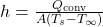
This is the foundation of nearly all laboratory techniques for determining h.
Common Experimental Techniques
Steady-State Methods
A heat source brings the surface to a stable temperature, and the heat flow is measured.
Examples include:
- Flat-plate heaters
- Pipe flow calorimeters
- Guarded hot-plate apparatus
These methods are simple and accurate when the system reaches equilibrium.
Transient (Unsteady) Methods
The temperature of the surface or fluid changes with time, and the transient response is recorded.
Typical examples:
- Transient hot-wire method (used for measuring gas and liquid thermal conductivity)
- Hot-film or hot-wire anemometry
- Cooling curves of heated objects
Transient techniques are useful for fast measurements or systems where steady state is difficult to achieve.
Heat Flux Sensors
Heat flux sensors directly measure the local heat flux q′′ on a surface.
Then h is evaluated from:

These sensors are widely used in aerospace, automotive, and electronics cooling applications.
Infrared Thermography
Infrared cameras capture the temperature distribution on a surface. When combined with known heat input, spatially varying values of h can be extracted. This technique is powerful for complex geometries and turbulent flows.
Role of Experiments in Engineering Practice
Even though theoretical methods are well-developed, experiments remain essential for:
- Model validation
- Developing empirical correlations
- Calibrating CFD simulations
- Designing heat exchangers and cooling systems
- Safety analysis and certification
The majority of widely used engineering correlations—including Nusselt number formulas, j-factor correlations, and many convection models—are based on experimental data.
10. Thermal Radiation
Heat can also be transferred without any physical medium, through electromagnetic waves emitted by matter due to its temperature. This mechanism is known as thermal radiation, and unlike conduction and convection, it does not require solid contact or fluid motion. Even in a vacuum, objects can exchange heat radiatively—this is why the Sun heats the Earth.
Nature of Thermal Radiation
All surfaces at a temperature above absolute zero emit radiation over a spectrum of wavelengths. The intensity and distribution of this radiation depend on the temperature and emissive characteristics of the surface. In heat transfer analysis, the key concepts are:
- Emissive Power (E): The total energy emitted per unit area.
- Emissivity (ε): A surface property (0 ≤ ε ≤ 1) describing how closely a real surface approaches an ideal blackbody.
- Blackbody: A perfect emitter and absorber of radiation; serves as the reference for radiation laws.
Stefan–Boltzmann Law
The total radiation emitted by a blackbody is given by: Eb=σT4E_b = \sigma T^4Eb=σT4
For a real surface: E=εσT4
Where:
- σ is the Stefan–Boltzmann constant,
- T is absolute temperature,
- ε is emissivity.
This relation shows the extremely strong dependence of radiation heat transfer on temperature—increasing temperature even slightly causes a large increase in radiative heat emission.
Radiative Heat Exchange Between Surfaces
When two surfaces exchange radiation, the net radiative heat transfer can be expressed as: qrad=εσA(Ts4−Tsur4)
for a surface exchanging radiation with its surroundings.
More complex situations—multiple surfaces, enclosure radiation, view factors—require using the radiation network method or radiosity method, but the core principle remains the same: radiation depends strongly on temperature and surface properties.
Key Characteristics of Radiation
- Occurs at the speed of light.
- Does not require a material medium.
- Becomes dominant at high temperatures (e.g., furnaces, engines, gas turbines).
- Depends on surface color, texture, and material.
Importance in Thermal & Fluids Engineering
Thermal radiation is essential in many engineering applications:
- High-temperature heat exchangers
- HVAC (radiative cooling, solar load calculations)
- Building energy performance (long-wave radiation exchange)
- Combustion chambers and gas turbine blades
- Spacecraft thermal control
Even in low-temperature engineering, ignoring radiation can result in significant error when the temperature difference is large or when surfaces have high emissivity.
11. Thermal Resistance Approach and Its Electrical Analogy
In many steady-state heat-transfer problems, especially in engineering applications, the thermal resistance method provides a simple but powerful way to model heat flow without solving the full differential equations.
This approach treats heat flow analogously to electrical current flowing through resistors. Because of its clarity, speed, and reliability, it is widely used in thermal design, building energy analysis, HVAC & R systems, electronics cooling, and power equipment.
I. Heat Transfer vs. Electrical Circuits: The Analogy
| Heat Transfer | Electrical System |
|---|---|
| Heat flow rate Q | Electric current I |
| Temperature difference ΔT | Voltage difference ΔV |
| Thermal resistance Rthermal | Electrical resistance Relectrical |
This leads to the thermal form of Ohm’s law: 
which mirrors: 
Heat flows easily when thermal resistance is small—just like electric current flows easily when electrical resistance is low.
II. Types of Thermal Resistances
Thermal resistance arises due to different heat-transfer mechanisms and material interfaces. Below are the key types used in engineering calculations.
A. Conduction Resistance
Plane Wall

Cylindrical Conduction (pipes, tubes)

Spherical Conduction

B. Convection Resistance
From Newton’s law:

Used for heat transfer between solid surfaces and fluids.
C. Radiation Resistance

A linearized representation of thermal radiation.
D. Contact Thermal Resistance
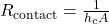
Important in electronics, bolted joints, and heat sinks.
E. Spreading Resistance
Occurs when heat flows from a small area to a larger one:

Important in chip cooling and heat sinks.
F. Fin (Extended Surface) Resistance
For any fin:

Fins lower overall resistance by increasing effective area.
III. Thermal Circuits
Thermal resistances combine just like electrical resistors.
Series

Parallel

Used to model:
- composite walls
- insulation systems
- surfaces exposed to convection + radiation
- multilayer building envelopes
- fins and heat sinks
- pipes with insulation layers
IV. Why the Thermal Resistance Method Is Important
The thermal resistance concept is not just a theoretical tool—it is one of the fundamental engineering methods used in real-world design, especially in HVAC & R.
Its Importance in HVAC & R Applications
Thermal resistance is central to:
✓ Heating and cooling load calculations
- U-values of walls, windows, ceilings
- Determining conduction losses through building envelopes
- Estimating infiltration and ventilation loads (via convective resistances)
✓ Pipe sizing and duct sizing
- Thermal resistance of pipe insulation
- Heat loss in hot-water and chilled-water piping
- Refrigerant line losses
✓ Selecting HVAC & R systems
- Determining required heating/cooling capacity
- Evaluating equipment efficiency (boilers, chillers, heat pumps)
- Understanding building thermal response and system performance
✓ Identifying and reducing thermal waste
- Heat leakage through poorly insulated walls
- Losses in ducts, refrigeration lines, and distribution systems
- Thermal bridging in building components
Thermal resistance makes complex heat-transfer problems intuitive and provides fast, accurate engineering estimates, which is why it is one of the most widely used tools in modern HVAC design and energy engineering.
12. Overall Heat Transfer Coefficient (U-Value) and Combined Modes of Heat Transfer
In real-world systems, heat often passes through multiple layers and interacts with different modes simultaneously: conduction, convection, and sometimes radiation. To simplify analysis and design, engineers use the overall heat transfer coefficient, commonly known as the U-value.
I. Definition of the Overall Heat Transfer Coefficient
The U-value represents the combined effect of all thermal resistances in a system. It is defined by: 
Where:
 = overall heat transfer rate [W]
- A = heat-transfer surface area [m²]
- ΔT = temperature difference
 = overall heat transfer coefficient [W/(m²·K)]
The U-value is the reciprocal of the overall thermal resistance:

Where Roverall includes all series and parallel thermal resistances:
- Conduction resistances of walls, pipes, and insulation layers
- Convection resistances on the fluid or air sides
- Radiation resistances (if significant)
II. Combining Thermal Resistances
For layers in series (e.g., wall with insulation):

For layers in parallel (e.g., wall with windows or multiple paths):
The U-value then allows us to calculate heat loss or gain through the composite structure.
III. Practical Importance in HVAC & R
The overall heat transfer coefficient is one of the most critical design parameters in HVAC and energy engineering:
- Building envelope design: Determine heating and cooling loads
- Heat exchangers: Evaluate performance and select equipment
- Piping and ducts: Assess insulation requirements and energy losses
- Energy efficiency studies: Identify thermal bridges and reduce waste
By using U-values, engineers can model complex systems with multiple layers and modes of heat transfer in a simple, intuitive, and accurate way.
IV. Combined Modes: Conduction, Convection, and Radiation
Often, heat is not transferred by a single mechanism:
- Conduction: Through solid layers of walls, windows, or pipes
- Convection: Between surfaces and fluids (air, water, refrigerants)
- Radiation: Between surfaces, particularly at high temperatures
Eventually, the thermal resistance network approach allows all three modes to be incorporated into a single effective U-value, making system-level energy analysis and HVAC design straightforward as:
which,
This section naturally leads to practical HVAC applications such as load calculations, system sizing, and energy audits.