
Thermodynamics
Thermodynamics is the science of energy—how it exchanges, transforms, and interacts with matter. It provides the fundamental laws that govern heating, cooling, power production and usage, and energy efficiency and optimization of energy consumption across all engineering systems. From understanding heat gain and loss in buildings to evaluating the performance of engines, turbines, and HVAC systems, and so on, thermodynamics forms the analytical backbone of modern thermal-fluid engineering. In this page, you’ll find clear explanations of fundamental laws, practical methods, and engineering applications that connect theory to real-world energy systems.
1. The Origins and Evolution of Thermodynamics
“Thermo” originates from the ancient Greek word thermē, meaning heat or warmth. The conceptual history of thermodynamics stretches back to the moment early humans discovered and controlled fire.
When human beings first learned to use fire for cooking, this discovery unlocked higher caloric intake from cooked food, which in turn reduced the time needed for hunting and gathering. This surplus of time allowed early humans to socialize more, cooperate, and develop increasingly complex forms of communication. It was during this period that the foundations of logos—reason, discourse, and structured thought—began to emerge. It is remarkable that two essential pillars of human civilization, “language” and “logic,” both trace their roots to the concept of logos. This connection highlights the profound impact that the mastery and application of fire had on cognitive development and social evolution. With more time to interact, early communities developed vocal communication first, followed later by dialectic forms of thought. The ability to transmit knowledge across generations created the earliest form of collective memory. This shared memory improved practical reasoning, enabled cumulative learning, and led to significant advances in tool-making and practical thinking.
Much later in history, the invention of the internal combustion engine accelerated human progress at an unprecedented rate. Combustion—the chemical process of burning, observable most clearly as fire—became the basis for modern power systems. Its controlled application revolutionized powertrains, power plants, and propulsion technologies. Most importantly, combustion-based systems enabled large-scale electricity generation. Electricity, being easily transported, transformed, and stored, became the most accessible and versatile form of energy. This marked a major milestone in the advancement of science, engineering, and technology, fundamentally reshaping human civilization.
The journey from the first controlled fire to today’s sophisticated energy systems is, in essence, the evolution of thermodynamics itself. What began as the simple use of heat for survival gradually transformed into a scientific understanding of heat, work, energy, and efficiency. As human knowledge expanded, fire was no longer just a source of warmth or cooking—it became a subject of measurement, analysis, and mathematical description. This transition marked the birth of modern thermodynamics, where the behavior of heat and energy is governed by universal laws. These laws now underpin the design and optimization of engines, heat pumps, refrigeration systems, power plants, propulsion units, and every technology that converts energy into a useful form. In this way, the ancient mastery of fire evolved into a disciplined field of engineering that continues to shape the technological world we live in today.
2. The Scientific Emergence of Thermodynamics
For centuries, humans watched steam can move objects and observed hot objects cooling—yet none of these everyday experiences led to the formulation of the First or Second Laws of Thermodynamics. Observation alone was not enough. These phenomena remained merely practical knowledge until scientists developed the ability to measure, quantify, and analyze them.
Only when we began asking why the lid of a boiling kettle moves, what causes steam to push against it, and how heat transforms into mechanical motion did the fundamental concepts of work, energy, and heat emerge as scientific quantities. By applying systematic experimentation and numerical analysis, early investigators established measurable principles such as conservation of mass and conservation of energy. They quantified the relationships between heat input, work output, and internal energy changes. Only through this process did the First Law of Thermodynamics become a scientifically expressed law—rooted not in everyday experience, but in quantified, repeatable measurements.
Similarly, humans have always known that a cup of tea cools down and never warms itself spontaneously, but this observation alone did not reveal the Second Law. It remained unexplained until scientists quantified thermal processes, compared their measurements across different systems, and recognized the universal directionality of natural phenomena. Through analytical reasoning and mathematical modeling, they identified the concepts of entropy generation, irreversibility, and later exergy destruction. These quantified insights ultimately led to the Second Law of Thermodynamics, which formalizes the limitations of energy conversion and the natural tendency toward disorder.
Without analytical thinking, methodological pathway, and quantification, thermodynamics would have remained a collection of observations—not a scientific discipline.
The Zeroth Law establishes the concept of temperature as a measurable and comparable property. It states that if two systems are each in thermal equilibrium with a third system, they are in equilibrium with each other. This simple principle forms the foundation of all temperature measurement and enables the design of thermometers and control systems in engineering applications. Without this understanding, the precise quantification of heat transfer—which underpins the First and Second Laws—would not be possible.
The Third Law states that as the temperature of a system approaches absolute zero, the entropy approaches a minimum value, often taken as zero for a perfect crystalline substance. The third law of thermodynamics has two important consequences: it defines the sign of the entropy of any substance at temperatures above absolute zero as positive, and it provides a fixed reference point that allows us to measure the absolute entropy of any substance at any temperature.
3. Exergy Analysis Concepts and Methods
Energy demand is one of the most pressing concerns today and will remain a critical challenge in the future. To achieve better performance in energy production and consumption, it is important to have a deeper understanding of the concept of energy. While there are different forms of energy, the energy concept can be defined as the summation of accessible and inaccessible terms as Energy=Exergy+Anergy. Exergy is the maximum accessible work, potential work, or quality of energy, while anergy is the inaccessible part.
From the perspective of the first law of thermodynamics, maximum accessible work can be achieved through a reversible work production process from the existing state to the ambient state, where complete equilibrium with the surroundings is maintained. Exergy provides a more effective measure of efficiency by assessing how well a system utilizes the potential energy. Since energy potential is directly related to the quality of an existing energy source, exergy can also serve as an economic metric that includes considerations of capital and operating costs.
From the perspective of the second law of thermodynamics, according to the Gouy–Stodola theorem, entropy generation is directly related to irreversibility. Irreversibility equals exergy destruction. The exergy balance accounts for exergy destruction. Exergy destruction shows environmental impact because the more exergy a system wastes, the more fuel it must burn, and the more emissions it produces. Consequently, entropy generation is directly linked to exergy destruction and environmental degradation. Therefore, exergy analysis can also assess the environmental impact.
In general, the exergy concept serves as a powerful technical tool for the thermodynamic assessment, optimization, and economic and environmental decision-making. Advanced exergy analysis even offers a more detailed evaluation.
Introduction
In an era of growing concern over energy efficiency and environmental sustainability, traditional methods of energy analysis are increasingly being supplemented with more advanced approaches. One such approach is exergy analysis, a powerful thermodynamic tool that assesses the quality of energy and quantifies inefficiencies within energy systems. Unlike energy, which is conserved according to the first law of thermodynamics, exergy is destroyed according to the second law of thermodynamics due to irreversibilities and losses, offering a more insightful measure of system performance and improvement potential.
This page provides fundamental knowledge on how to perform energy analysis, which is an essential step prior to conducting exergy analysis. It then introduces the definitions and methodology of exergy analysis. The importance of exergy analysis in conjunction with the entropy balance equation and the Gouy–Stodola theorem is discussed. It is explained that, although the entropy balance equation may be applied earlier, the exergy balance equation is still necessary for better definition. While the Gouy–Stodola theorem provides the link between entropy generation and irreversibilities, exergy analysis offers a more practical and insightful approach with the exergy destruction term. Exergy analysis helps with optimization and performance improvement by identifying the location, magnitude, and causes of inefficiencies in a system. Unlike energy analysis, exergy analysis distinguishes between useful and wasted energy, allowing engineers to target components with the highest exergy destruction. This leads to more effective design modifications, improved resource utilization, and enhanced overall system efficiency. Furthermore, it is explained how exergy analysis is connected to both economic analysis and environmental impact assessment, making it a powerful tool for evaluating and improving system performance from both financial and sustainability perspectives. Furthermore, key differences between conventional and advanced exergy analyses are addressed to achieve more detailed analyses and better improvements. Finally, this page highlights the importance and several application areas of exergy analysis and discusses its effectiveness in the evaluation and optimization of energy systems.
While this topic is well known within the thermal sciences and energy engineering communities, this page is designed to be accessible to a broader audience, including those new to exergy concepts. Basic principles are clearly explained, with emphasis placed on their relevance to real-world energy systems. The aim is to provide a solid foundation for both academic study and practical implementation in energy systems analysis and design.
I. Energy Analysis
Energy analysis is the first and essential step before performing exergy analysis, as it helps determine all the unknown properties of an energy system. The following steps are the typical routine procedure of an energy analysis.
Mass conservation (continuity)
By neglecting Einstein’s mass-energy equivalence (E=mc2) and assuming that flow velocities are much lower than the speed of light, the rate of change of mass within a control volume is given by the difference between the inlet and outlet mass flow rates, and can be expressed as:

which mi and me are the inlet and outlet mass flow rates, respectively.
Energy conservation (1st law of thermodynamics)
Again, by neglecting Einstein’s mass-energy equivalence (E=mc2) and assuming that flow velocities are much lower than the speed of light, energy cannot be created or destroyed, only transformed from one form to another. Thus, the rate of change of energy within a control volume can be expressed as:

which E=m(e) and Q, W, and e are heat, work, and specific energy, respectively.
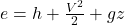
h, V2/2, and gz are specific enthalpy, kinetic, and potential energy terms, respectively.
Entropy balance (2nd law of thermodynamics)
While entropy is often associated with disorder and chaos, it’s more accurately described as a measure of the number of possible microstate arrangements a system can have, and thus a measure of energy dispersal or the tendency towards a more random state. While an ideal process (ΔSgen=0) assumes no change in entropy, the entropy in real processes (ΔSgen>0) is not conserved and can be calculated using the entropy balance for a control volume as follows:

which S=m(s), and s is specific entropy.
By restating the entropy equation, the entropy generation is:

Gouy–Stodola theorem
Based on the Gouy–Stodola theorem, for a control volume with the ambient temperature of T0, the irreversibility value is calculated as:

which I is the irreversibility value, and ΔSgen is the entropy generation of a thermodynamic process because of irreversibilities.
Supplementary equations
In addition to the previously mentioned equations, supporting thermodynamic relations such as the state equation of an ideal gas, isentropic, and polytropic formulas should be applied to perform the energy analysis for each system component.
For the steady state steady flow (SSSF) thermodynamic processes, all the temporal terms equal zero (d/dt=0).
Energy efficiency or thermal efficiency (1st law efficiency)
Energy efficiency is the ratio of useful energy output to the total energy input of a system as:

Energy efficiency indicates how much energy has been conserved.
II. Conventional Exergy Analysis
When the energy analysis is accomplished, all unknowns (thermodynamic properties) of the system are calculated. Then, the exergy analysis is simply implemented by using the new exergetic definitions of the components and the entire system.
The concept of exergy
Exergy is the maximum useful work that can be extracted from a system as it comes into equilibrium with its environment. Exergy is defined as:

which exergy and anergy are the maximum accessible work and non-accessible work, respectively. In fact, exergy is a meaningful definition of the energy term.
Definition of the environment from the exergy analysis point of view
From the point of view of exergy analysis, the environment of a system is completely in a thermodynamic equilibrium. There are no gradients in the environment, including pressure, temperature, and chemical potential gradients. In addition, it is not possible to obtain work from the interaction of different components of the environment with each other. Therefore, in exergy analysis, the environment is a reference used to evaluate the performance potential of different systems.
Restricted dead state and dead state
The restricted dead state is a state of the substance in which it is in thermal and mechanical equilibrium with the environment. However, they are not in chemical equilibrium with each other. In the restricted dead state, the substance’s temperature and pressure are equal to the ambient temperature and pressure, and the velocity and potential energy of the substance are zero. The dead state is a state of the substance in which it is not only in thermal and mechanical equilibrium but also in chemical equilibrium with the surrounding environment.
Exergy balance
Unlike energy, exergy is not conserved; it can be destroyed due to irreversibilities (like friction, heat transfer, mixing, etc.), which are associated with entropy generation.
For each component:

which Ex=m(ex), and ExD is the exergy destruction of a component. Since exergy destruction within a component is caused either by its own internal irreversibilities or by interactions with other components that also have their own irreversibilities, the total exergy destruction can be viewed as the sum of all these irreversibilities and can be defined as:

which I is the irreversibility value.
For the entire system:

which ExD,system is the total exergy destruction of a system, and ExD,loss is the exergy loss due to the exhaust or unutilized exergy term, which is defined as:

Again, for the SSSF thermodynamic processes, all the temporal terms equal zero (d/dt=0).
Exergy types
In the absence of the effects of nuclear, magnetic, electric, and surface tension fields, the exergy can be written as a summation of physical, chemical, kinetic, potential, mechanical work, and heat transfer exergy parts as:

The physical exergy (Exph) is the maximum accessible work that a substance can do in a reversible process, as a substance goes from its initial state to the restricted dead state:

The chemical exergy (Exch) is the amount of accessible work a substance can do in the chemical equilibrium process surrounded by an environment in which a substance goes from the restricted dead state to the dead state. One of the important applications of the concept of chemical exergy is the calculation of fuel exergy. For hydrocarbon fuels with the form CnHm, the amount of chemical exergy is obtained from:
![Ex_{\text{ch}} = -\Delta g(T_0, P_0) + T_0 R \ln \left[ \frac{\left(y_{0,O_2}\right)^{n + m/4}}{\left(y_{0,CO_2}\right)^n \left(y_{0,H_2O}\right)^m} \right]](https://buildingenergylab.com/wp-content/ql-cache/quicklatex.com-92278d475c653806208059fd91ba42e7_l3.png "Rendered by QuickLaTeX.com")
which R, y, g are the universal gas constant, molar fraction, and Gibbs function, respectively, and:

The chemical exergy of a mixture of ideal gases can be obtained from the following equation:

The kinetic exergy of equation (Exk) can be calculated as:

The potential exergy of equation (Exp) can be obtained as:

Based on the definition of the exergy, mechanical work (Exw) equals exergy:

The exergy of heat transfer (Exq) is the maximum work that can be obtained from the thermal energy transfer as:

Exergy efficiency (2nd law efficiency)
Exergy efficiency measures how effectively a system converts available energy (exergy) into useful work or output, considering irreversibilities.

Exergy efficiency shows how effectively the available energy has been utilized.
III. Advanced or Enhanced Exergy Analysis
Conventional exergy analysis evaluates exergy destruction and exergy efficiency for each component or system, and identifies where inefficiencies and losses happen. It can also help prioritize components or subsystems for improvement. But there are some limitations. The conventional exergy analysis doesn’t differentiate the causes of exergy destruction, treats all irreversibilities as if they are equally avoidable. Moreover, it doesn’t consider interactions between components or real-world constraints (e.g., economic or technological feasibility).
On the contrary, advanced or enhanced exergy analysis splits exergy destruction into meaningful categories to gain deeper insight. The typical classifications are:
Endogenous vs. Exogenous:
- Endogenous: Destructions due to the component itself, assuming ideal conditions in the rest of the system.
- Exogenous: Destructions caused by interactions with other components.
Avoidable vs. Unavoidable:
- Avoidable: Destructions that could be reduced with better technology or design.
- Unavoidable: Destructions that are inherent due to current technological or physical limitations.
Advanced or enhanced exergy analysis helps identify true improvement potential, separates technical limitations from design inefficiencies, and shows which components are affected by system-level design choices.
Key differences between conventional and advanced exergy analyses
| Aspect | Conventional Exergy Analysis | Advanced/Enhanced Exergy Analysis |
| Depth of Insight | Basic (how much exergy is destroyed) | Detailed (why, where, and whether it can be improved) |
| Categories | No decomposition | Decomposes into avoidable/unavoidable and endogenous/exogenous |
| System Interactions | Not considered | Explicitly considered |
| Improvement Potential | Generic | Targeted and realistic |
| Decision Support | Limited | Much more informed and effective |
Conventional exergy analysis can sometimes be misleading or “illusory” because it treats all exergy destruction as equally significant and does not reveal the true potential for improvement. It fails to differentiate between the inherent limitations of system components and the inefficiencies that can actually be reduced. In contrast, advanced exergy analysis offers a more realistic and insightful evaluation by separating exergy destruction into avoidable/unavoidable and endogenous/exogenous parts. This distinction allows engineers to identify where real improvements can be made, providing a more effective basis for design optimization and decision-making.
4. Importance of Exergy Analysis
The entropy balance alone is necessary but insufficient for engineering decisions. The entropy balance tells us where entropy generation (disorder) occurs in a system, but this value has no direct measure of value or cost. High entropy generation means losses, but how bad is it? What’s the impact? That’s where exergy analysis comes in.
Gouy–Stodola makes the link between entropy generation and irreversibilities, but exergy analysis makes it practical by bridging irreversibilities with exergy destruction. Only exergy analysis quantifies where and how much useful work is lost, allows comparison of component-level inefficiencies, and supports optimization, not just diagnosis.
Exergy analysis adds technical, economic and environmental relevance. Entropy is a purely important thermodynamic quantity, but abstract. Exergy, on the other hand, tells you how much potential work is wasted. Exergy can be linked to performance, cost, and environmental impact.
Exergy analysis links with economic analysis by quantifying the quality and usefulness of energy flows, allowing for the identification of where and how energy degradation occurs in a system. Unlike energy analysis, which only considers the quantity of energy, exergy highlights inefficiencies by measuring how much work potential is lost due to irreversibilities. This information helps prioritize cost-effective improvements by pinpointing components with the highest exergy destruction, which often correlate with higher operating costs. As a result, integrating exergy analysis into economic evaluation supports more informed decisions for optimizing both energy performance and financial investment. Therefore, exergy analysis gives designers and analysts a tool for engineering decisions, not just physical insights.
Exergy analysis links with environmental impact by identifying where and how irreversibilities in energy systems lead to entropy generation. Since exergy destruction directly reflects inefficiencies, it correlates with increased fuel consumption and pollutant emissions. By minimizing exergy losses, systems can operate more efficiently, reducing the demand for natural resources and lowering greenhouse gas and other harmful emissions. Thus, exergy analysis provides a powerful tool for assessing and improving the environmental sustainability of energy systems. Therefore, exergy analysis helps pinpoint not just where energy is wasted, but where environmental harm is caused.
Additionally, the advanced exergy analysis helps to elaborate on the causes of inefficiencies and the potential for realistic improvement in each component and the entire system. Unlike conventional exergy analysis, the advanced approach offers deeper insights into how component interactions and operational limits affect system performance. Ultimately, this allows for more informed and targeted strategies to optimize the system’s overall efficiency.
In Summary, using entropy balance and the Gouy–Stodola theorem gives you the thermodynamic roots of entropy generation and irreversibility. But exergy analysis is necessary to make that information useful and actionable, guide system design, efficiency improvement, and optimization. Exergy analysis translates “entropy generation” into “lost potential work”. This provides a way to measure both the quantity and quality of energy, making it a powerful tool for identifying inefficiencies and optimizing thermal systems. In other words, while the entropy balance and the Gouy–Stodola theorem reveal the presence and magnitude of entropy generation and irreversibilities in thermodynamic systems, exergy analysis is essential to assess their practical impact. It translates entropy generation and irreversibilities into the destruction of useful work potential, thereby providing a more intuitive and engineering-relevant framework for performance assessment, parametric study, and optimization. Unlike energy or entropy alone, exergy connects thermodynamic performance with economic cost and environmental impact by identifying where efficiency losses lead to increased operating expenses and emissions. These make exergy analysis a practical and comprehensive tool for technical, economic, and environmental decision-making. Advanced exergy analysis enables even more intelligent engineering solutions, economically efficient system upgrades, and more sustainable, environmentally conscious decision-making.
5. Application Areas of Exergy Analysis
Exergy analysis is a versatile and insightful thermodynamic approach widely applied in various engineering and industrial domains to assess and optimize the efficiency of energy production, conversion, and utilization processes and systems. Unlike traditional energy analysis, exergy analysis considers both the quantity and quality of energy, enabling the identification of true inefficiencies and guiding system improvements. Its application spans power plants, powertrain, propulsion, refrigeration, heating ventilation and air conditioning (HVAC) systems, building energy performance, renewable energy systems, industrial processes, aerodynamic performance, human activities, biological and biochemical systems, non-equilibrium processes, resource management, policy making, among others. Exergy analysis supports system optimization, waste reduction, and informed decision-making for design and operation, making it essential for developing high-efficiency, low-impact technologies in an increasingly energy-conscious world. Moreover, by integrating economic and environmental dimensions through exergo-economic and exergo-environmental analyses, it becomes possible to evaluate the cost-effectiveness and ecological impact of exergy destruction and losses. This comprehensive framework supports the design of systems that are not only energy-efficient but also technically feasible, economically viable, and environmentally sustainable.